Showing posts with label Featured Cookbook. Show all posts

Saturday, March 13, 2010

Its time for another installment of: Featured Cookbooks and Bibliomancy!

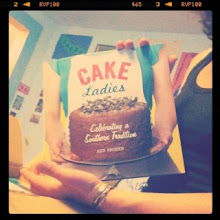
Today I will be reviewing the classic Southern Heritage Cakes Cookbook! (Southern Heritage, Oxmoor House, 1983)

Jenne gave me this book a few months back, which, as you can see from the picture, she purchased at Mr. K's Used Books for four dollars. Mr. K's, which is located at River Ridge on Fairview Road, is apparently awesome- though I have never been there.
I fell in love with the book immediately. Not only are the recipes dead-on, but the pictures and clip art are rich with cake love and lore. There is historical context given for many of the recipes, and many of the recipes are illustrated with step-by-step photos.
Like much of our history as Southerners, there is some painful stuff, too, like the recurrent images of Black Mammies that were so prevalent in literature about the South for the last century. Complicating the story further is this historical tale of the Sam Houston Cake, whose namesake was adopted by the Cherokee nation, then became a soldier and slaveowner, and then the governer of Texas.

I particularly like the entries on cooked icings, as there are no mainstream cookbooks (even my beloved Joy of Cooking) that correctly treat the steps for popular Southern cooked icings (such as Cooked Caramel Icing, Seven Minute Icing- called Divinity in other parts of the country- and custard-based cooked icings such as German Chocolate Cake Icing).
All in all, the Southern Heritage Cakes Cookbook is a gem- which is probably why I see it on the shelves of many of my crafty, culinary colleagues (I'm talking to you, Ashley Adams English!)
This book is easy to procure used and will serve you well.

And now: for the bibliomancy- a form of mystical divination where I flip through the pages of the featured cookbook with my eyes closed and randomly choose a recipe or passage. (this one's for you, Egg!)

"'Early rising is also essential to the good government of a family. A late breakfast deranges the whole business of the day, and throws a portion of it on the next, which opens the door for confusion to enter.' In spite of what Mary Randolph admonished in 1831, these coffee cakes are delicious for a late breakfast- and are guaranteed not to ruin your day."

And there you have it.
xo

Friday, September 26, 2008

"The Gift of Southern Cooking" Cookbook Review and Bibliomancy Part 3

This is a lovely night on Short Street. Its late September, with a slightly chilly drizzle outside. The cakes and icings are all really fresh and happy from the cool weather. Eileen and I have been working all day on the three weddings plus the Blogapolooza Cake. Its been a good, productive day, and I'll be working into the night and all day tomorrow. I got to take a break and get pizza with my family a little while ago. They left to go to a party and I came home to bake- so I'm feeling rejuvinated and listening to loud music and having a Friday night by myself in the bakery/house.
And I feel inspired to write tonight while I bake, about a recipe book I love, called "The Gift of Southern Cooking" by Edna Lewis and Scott Peacock.
And now I'm going to mix up several batches of lemon cake and put them in the oven and come back and write some more.
***
I would like to say that Beck's "Midnight Vultures" is a freaking great album.
***
I would like to add that there is a huge amount of dishwashing involved in this project.
***
And now:

"The Gift of Southern Cooking, Recipes and Revelations from two great American cooks," is a collaboration between the late Edna Lewis, storied and celebrated Southern chef, and Scott Peacock, Executive Chef at Atlanta's Watershed Restaurant. The two (one a young, white, gay man and the other an eldery black woman) had a long and enduring friendship that included them living together in Peacock's Decatur, GA home for the last 10 years of Miss Lewis' life. Their stories that unfold in the pages of the book are touching, and dignified, and interesting, from Scott's upbringing in rural southern Alabama, where he remembers picking field peas and making chowchow with his family, to Miss Lewis' hipster bohemian days in New York in the 1940s as the chef of the Cafe Nicholson, which was frequented by guests such as Truman Capote, Marlene Dietrich and Tennessee Williams.
And the recipes, the recipes are beautiful.
Where to begin? The lard biscuits. The Lemon Cheese Cake (which is not a cheesecake but a layer cake iced with lemon curd, or "cheese"). The okra pancakes. The cardamom-scented sugar cubes. The snapper. The deviled eggs. The AMBROSIA! Who would have thought that I could love an Ambrosia without marshmallows and maraschino cherries? But their simple rendering, with only oranges, coconut, sugar, cream sherry, and salt, is sublime.
Am I gushing? I'm not exaggerating. Their recipes are nothing less than an exquisite, subtle harmony between intuitive, seasonal, necessity-based seasonal home cooking and high culinary art born of imagination and studied professionalism. And the regional balance of Miss Lewis' Virginia upbringing- where the cuisine is much more informed by French and English cooking as well as cooler-weather crops- and Mr. Peacock's Gulf Coast-influenced culinary roots, is enlivening to the recipes, as well.
Other highlights are a description of the plantation history of the "cake walk" and the origin of the phrase "that takes the cake;" and beautiful photographs of the striking Miss Lewis from past decades, as well as beautiful photographs of Mr. Peacock and Miss Lewis together.

Like all good cookbooks, love is deep in every page, and in this case, its not just the love of food, or a landscape, or a time gone by that one feels when using it. I think it is also the love that the two great chefs have for one another that ultimately makes this cookbook so, well, beloved.
I love this book, the biscuits are my staple, and if you get a chance to pick up a copy, I think you'll be glad you did.
And now, for the bibliomancy:
"Corn pudding is a true Southern delicacy, and one of the great treats of summer. It can be served as a light supper dish, as an accompaniment to meat, or as a part of a vegetable plate. Use only the freshest corn, and bake until just set for the best texture."
There you have it. Part 3 of the Cookbook Review and Bibliomancy Series on My Life in Cake.
2 of the lemon cakes have fallen and I need more sour cream.
I'm tired and I'm going to bed and I'm going to start over on them in the morning.
xo
Jodi

Thursday, August 28, 2008

Cookbook Review and Bibliomancy Part II: Heart of the Home by Ann Jackson


So, for my next installment of "Cookbook Reviews and Bibliomancy," I want to introduce one of my favorites: Heart of the Home, by Ann Jackson. Relatively obscure and hard to find (I had to special order mine from Malaprops), this book was published in 1995 and re-released in 2000. The book was introduced to me by Cathy Cleary of the West End Bakery. It seems that Ms. Jackson and I are of the same mind when it comes to food: recipes must be simple and intuitive, but fresh and innovative at the same time. I love the recipes, which are all vegetarian and often include vegan options, but what I love the most about this cookbook is the commentary, quotations, the copious ironic 50's housewife vintage clip art throughout, and the hilarious stories that precede most recipes. The recipes are flexible, too, encouraging the cook to substitute, experiment, and above all, be practical. Ms. Jackson is undeniably country, Tennessee country at that, and nothing says country like the utilitarian home economy demonstrated in these recipes.
There are sections for "Salads and Dressings," "East Tennessee Favorites" (where you will find step by step instructions for vegetarian collards, hoppin' john, and red eye gravy, and the cornbread recipe that I use- "Flawless Cornbread"- which is flawless, every time.) There's sections for vegetables, grains, a WHOLE section for sauces and gravies, with no fewer than 17 different sauces and gravies (I mean, really, without the benefit of sausage, that's alot of different kind of gravies). My favorite from that section is the "White Woman's Barbeque Sauce" which includes fresh grated ginger juice, molassas, cayenne, and miso, among many other things. There's a pie section, a "main courses" section, and one for soups and one for "leftovers." The sections on "Outdoor Cooking" and "Bag Lunches for Bag Ladies, or, A Little Something for a Truck Driving Man" are excellent, funny, and smart. But of course, my favorite sections are the "Breads" and "Sweets" sections, with the best Old-Fashioned Gingerbread recipe ever. I used to make that gingerbread recipe when I was pregnant, and eat the whole damn thing. In an hour. Molasses is really good for you when you are pregnant. But, above all this, my very very favorite thing about this cookbook is the last two pages: The "Household Hints" section. I'll give you a sample from household hint #15: "What if the oven blows up in your face? This can be hectic. This is also the reason that good cooks have an aloe vera plant around the house.... Try not to let the experience scare you. Go right back into the kitchen, otherwise, you may never bake another apple pie for as long as you live."
Friends, Heart of the Home is a warm and sweet creation from a cook after my own heart. The book is quirky, kooky, and it has as its base the understanding that the highest form of cooking is cooking for those you love.

And Now For The Bibliomancy (where I flip through the pages with my eyes closed and randomly choose a recipe or passage that will have some kind of deep occult meaning for all of us):

"When I make tortillas I flash back to an ancient lifetime, a brown wrinkled old lady squatting in front of a fire, rolling out tortillas on a rock. It seems every culture has its own version: crepes, strudel, pasta, shortbread, hoecakes, dumplings, chapati, biscuits, pancakes, knish, and pirogi. I love recipes that haven't changed in 5,000 years. Some are a lot easier than others, but most of them are pretty simple, made from basic peasant type food. Tortillas are my favorite, here's how to do it..."

That's all, friends. Stay tuned for more in this series, as well as another series I'm contemplating starting: Profiles In Cake. or something like that. Basically, just interviews with my favorite cake ladies. more soon, mwah.

Saturday, August 9, 2008

Cookbook Review and Bibliomancy Part I: The Joy of Cooking

This is the first in an ongoing series of blog posts on My Life In Cake featuring my favorite cookbooks. These are my tried-and-true, all-time favorite, recipe-books-I-read-in-the-bathtub kind of books. They will be in no particular ranking, or order, chronologically or numerically or according to the "best," "second best," etc. However, since my favorite cookbooks have become sort of sacred texts to me, I find that they are useful not just for recipes, but for spiritual guidance as well. Therefore, at the end of each of my cookbook reviews, I'll do a little biblomancy for you, gentle reader.
Without further ado: the first featured favorite cookbook has got to be (duh):

The Joy of Cooking was originally written by Irma S. Rombauer (with revisions carried out by her children and grandchildren, all Rombauers or Beckers). She self-published her cookbook in 1931, when she was a struggling single mom. Now she has left a cookbook empire to her children and grand children. (I think I met one of her great-grand-children at a party in my kitchen about 7 years ago. It was a kid who went to Warren Wilson. I was so in awe, man.)
Anyway, the Joy of Cooking.
C'mon. Its the bible. The Joy of Cooking (or just "Joy" as it is referred to in culinary circles) is simply the best, most comprehensive, most clear and well researched recipe book there is. Its also written in a very prim and proper, loveable-matronly-aristocrat voice, which somehow I love. When I used to live in Athens, Ga, my roommates and I used to entertain ourselves by doing dramatic readings of Joy recipes. My favorite is the Crepes Suzette recipe, which recounts the legend of the invention of the dessert, which like many good ideas, started by the thing the chef was originally trying to make ending in complete disaster. I won't recount the entire story here, but let me just say, its high drama, and it ends with: "and the dish was a triumph!" The point is, when relevant, Joy includes thorough background information on the recipes, their origins, and how they work and why. If you've ever tried to write a recipe, like a true how-to, you know it is not as easy as it looks, but Joy manages to communicate methods with clarity and levity.
I've accumulated three versions of Joy: the 1943 "wartime edition" (pictured) that I inherited from my Husband's Great-Aunt, one from 1975 that I stole from my mom, and the most recently updated edition, which came out in 2006 (a Christmas gift from my husband- thanks baby!). They are all great in their own way. The WWII one has lots of fancy drink recipes, but also lots of frugal recipes and "more with less" inspirations for the home economy. In the forward Irma promises to help us "make palatable dishes with simple means and lift everyday cooking out of the commonplace." swoon. The 70's version has lots of info on killing and dressing game (useful for us possom- and squirrel- eating Southerners), as well as many many options for making that best loved and overused convenience food of the 60's and 70's: the casserole. The 2006 edition is beautiful, huge, and features more international and vegetarian recipes than ever before. One can never read all the information in Joy. There are always new recipes to be tried. When you are standing in front of your refrigerator, trying to figure out how to make dinner with a half cup of leftover black beans, some sausage, a can of water chestnuts and a cassava root, Joy will tell you how.
Um, and that's the end of my feature on the Joy of Cooking.

So now for the Bibliomancy! I will now flip through the pages of each edition with my eyes closed and randomly choose a recipe or passage that will have some kind of deep occult meaning for all of us:
1943: "The question of how to cook apple butter is a moot point. Some cooks cook it very slowly, others prefer a quick heat."
1975: " Sauce Chaud-Froid is so called because it begins as a heated sauce and is served as a cold one."
2006: "The more pungent rums from the French islands of Guadeloupe and Martinique can achieve great subtlety and complexity when well aged and can be served like fine brandy in a snifter. Don't waste these fine rums in mixed drinks."

Hm, interesting. Obviously our spiritual lesson for the day is that discernment, balance, and listening to our inner wisdom will lead us to greater enjoyment in our lives.

the end.


Oh wait, PS, you should also check out Bake and Destroy Natalie's final project for her zombie class in college: The Joy of Cooking Humans